01
Platform limitations
The business needs a workflow or customer experience the current platform was never designed to support.
We design and develop custom websites and content platforms around the way your business actually works. You control the code, content, repository, infrastructure accounts, and future roadmap.
30-minute strategy call. No pressure. We will tell you whether to keep, improve, or replace the current platform.
AAMG CMS keeps everyday website work practical: pages, media, SEO, forms, users, navigation, submissions, integrations, security, and visual editing without a marketplace of unrelated plugins.
A business website should be an asset you can move, improve, integrate, and extend. Several “no” answers usually point to a platform or agency dependency problem.
Can you change development teams without rebuilding the website?
Can you move the platform to another hosting provider?
Can your company access the complete source-code repository?
Can new functionality be added without stacking more plugins?
Can the website connect cleanly with your CRM and operating systems?
Can you export content and business data in a usable format?
Can the platform evolve into a portal, dashboard, application, or customer system?
A new color palette will not fix plugin debt, developer dependency, disconnected operations, or an architecture that cannot support the next stage of the business.
The business needs a workflow or customer experience the current platform was never designed to support.
Simple functionality depends on several third-party products with separate updates, subscriptions, and failure points.
Only the original agency understands the website, making ordinary changes slower, riskier, and more expensive.
Leads, bookings, payments, customer data, documents, and reporting live in systems that do not communicate properly.
We are not against WordPress, Shopify, Webflow, or other established platforms. They work well when the requirements match. We recommend custom architecture when the mismatch starts costing the business.
We earn the ongoing relationship through delivery and support, not by making the platform difficult to move or understand.
The approved project repository is created in or transferred to a client-controlled account.
Domain, hosting, database, analytics, and related production accounts stay under your company’s control.
Approved interface files, components, brand assets, and supporting materials are included in handover.
Your team receives practical notes covering architecture, integrations, deployment, and administration.
Business content and data remain accessible, structured, and exportable instead of trapped in an agency workflow.
You can continue with AAMG, hire internally, or appoint another qualified development partner.
The interface remains focused because only the modules your business needs are included. New capabilities can be added as the operating model grows.
The admin panel is already built. These pages present the current product without changing its interface or workflow.
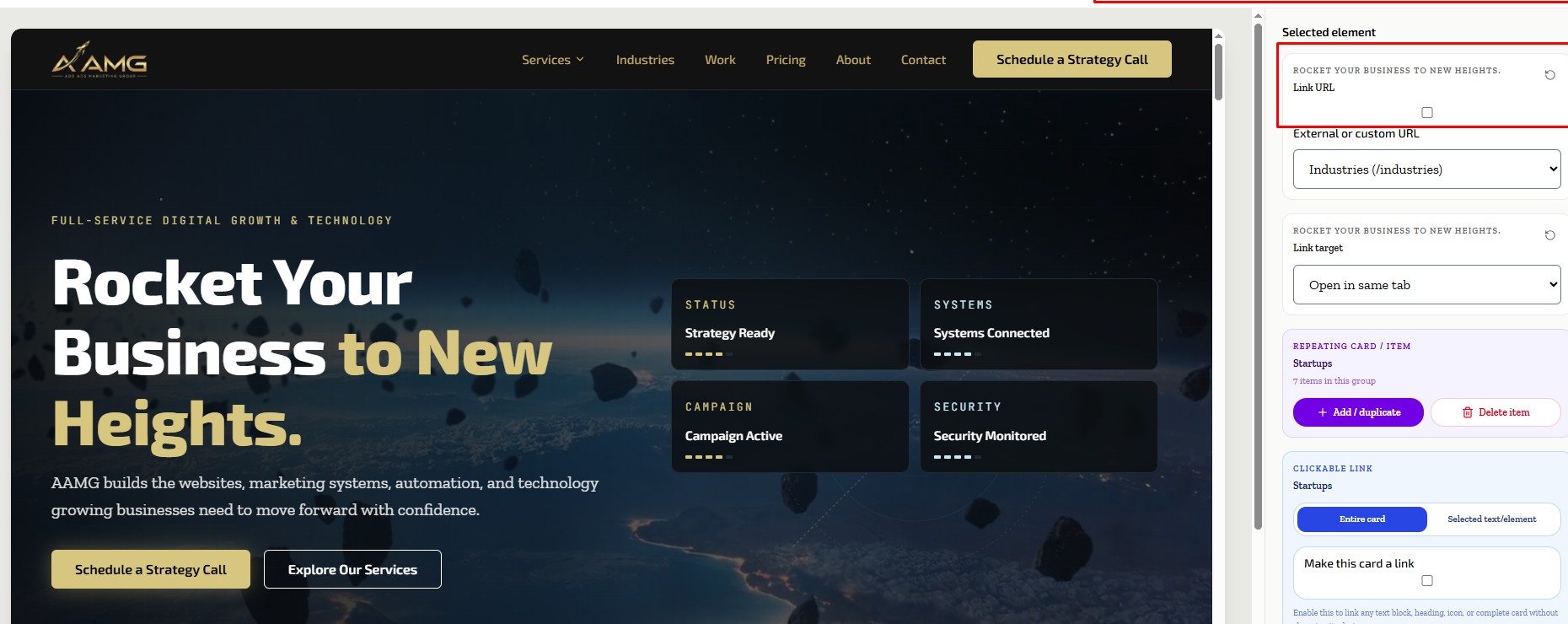
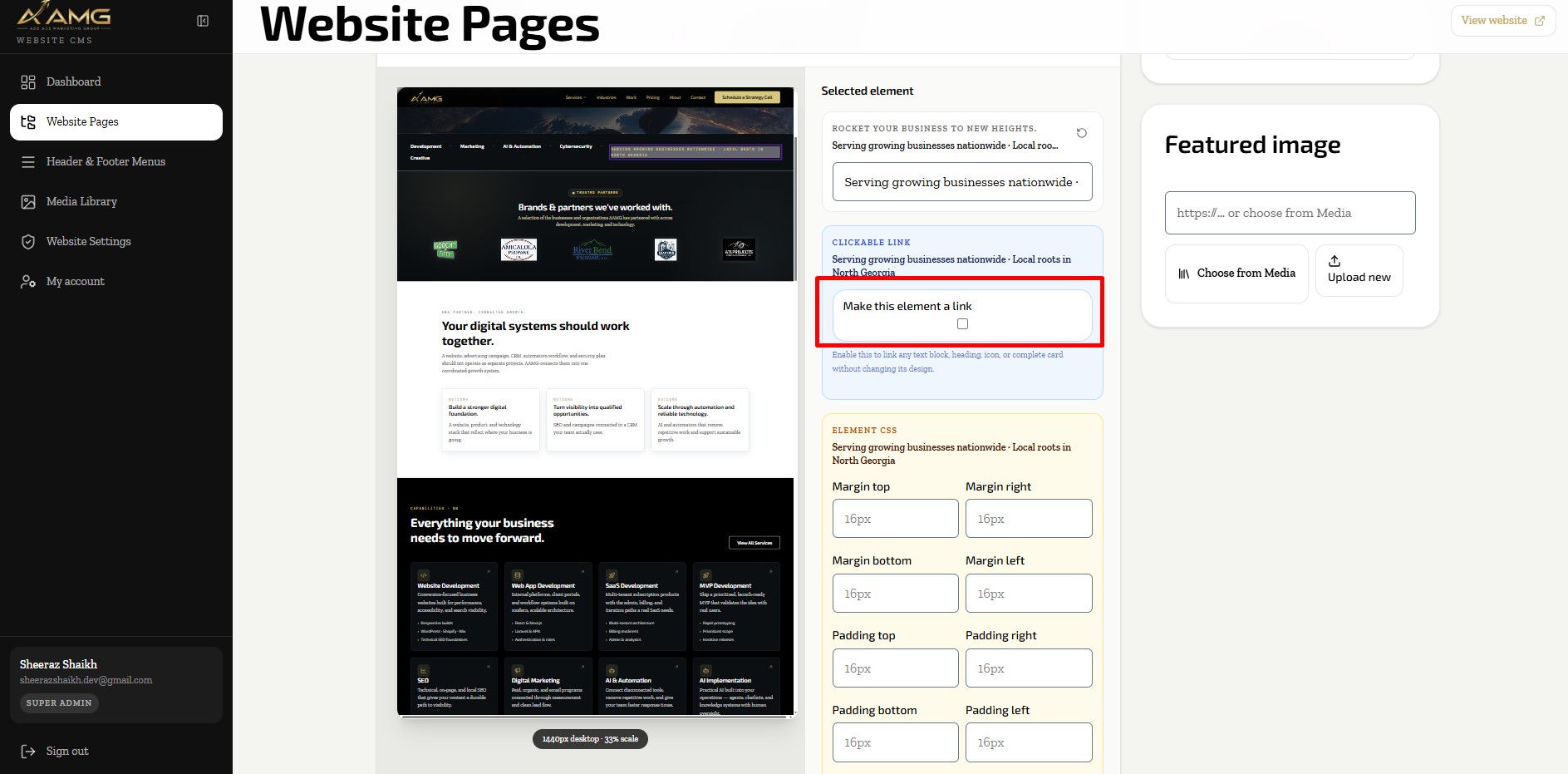
Select visible content and update text, links, images, sections, spacing, backgrounds, overlays, and responsive presentation while preserving the approved design system.
Manage drafts, published pages, deleted content, URLs, SEO, media, duplication, revisions, and access from a single focused workflow.
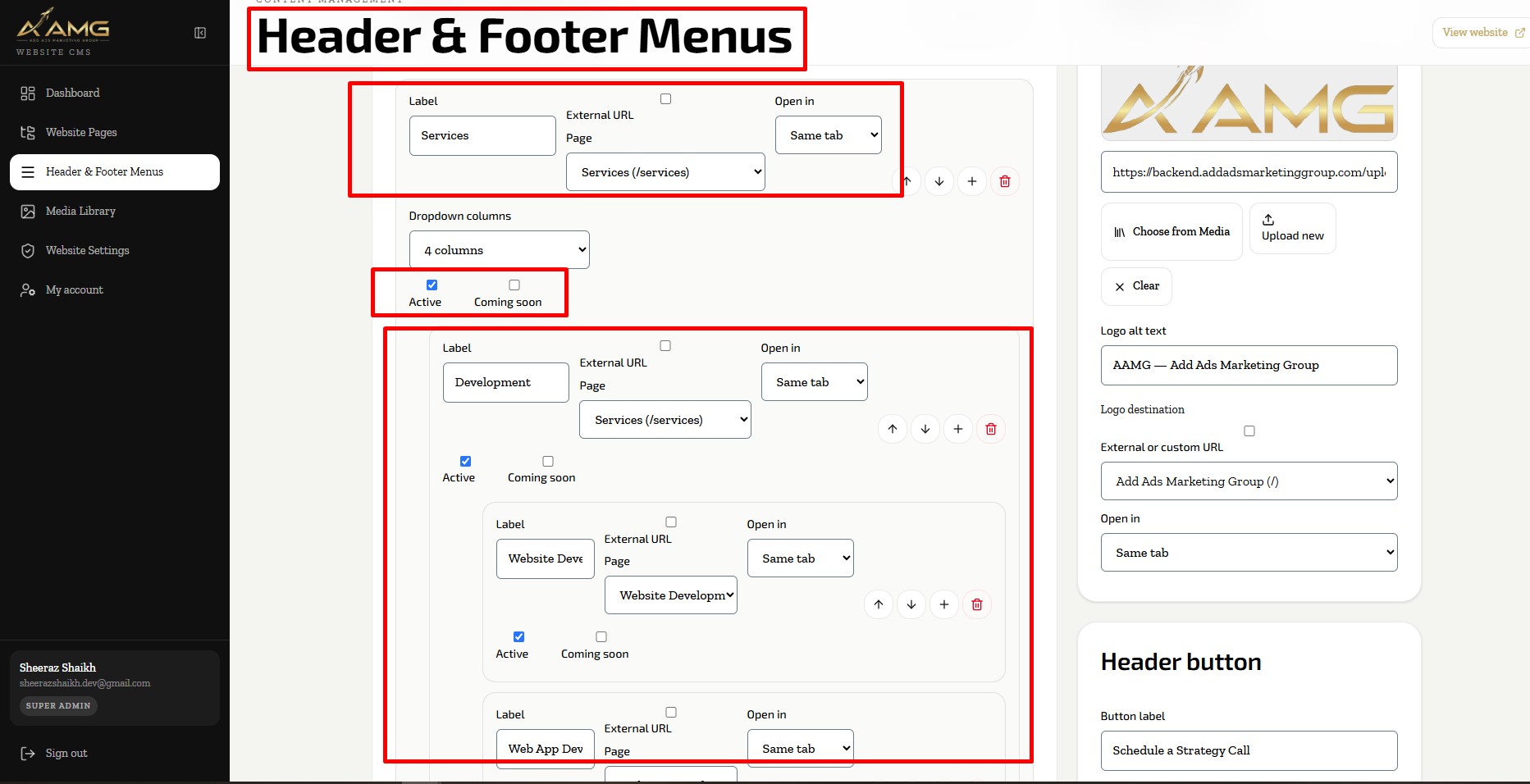
The management experience is designed around the actual website system, not a collection of unrelated third-party panels.
The initial website can become the foundation for customer portals, internal tools, automation, reporting, applications, and proprietary digital products.
Manage pages, services, locations, resources, case studies, products, announcements, and structured content.
Give administrators, marketers, editors, sales teams, partners, or regions the correct level of access.
Connect leads, appointments, payments, customer records, internal alerts, and reporting.
Modern delivery, optimized media, clean code, caching, and efficient infrastructure.
Metadata, sitemaps, redirects, schema, structured content, and search-friendly architecture.
Measure calls, forms, bookings, registrations, purchases, and qualified lead actions.
Protected forms, access control, session management, audit logs, and server hardening.
Add assistants, document extraction, lead routing, personalized experiences, and workflow automation.
Extend into customer, dealer, employee, member, or partner experiences when required.
Connect the website, CMS, mobile products, external systems, and future tools through controlled endpoints.
Run the platform through accounts your company controls with a documented deployment process.
Prepare the team to manage content and give future developers enough context to take over.
The difference is not only design. It is who controls the foundation, how the system operates, and whether it can support the next business requirement.
The architecture, ownership model, scope, and responsibilities are agreed before development begins. Progress is demonstrated throughout the project.
We review your current website, technology, content, access, performance, integrations, risks, and ownership arrangements.
We map customers, page structure, content types, roles, integrations, migration requirements, and future functionality.
The public website and administrative experience are designed around your brand, customer journey, and internal team.
We build the frontend, AAMG CMS modules, integrations, analytics, SEO controls, permissions, and required workflows.
Approved content is migrated and tested across devices, browsers, forms, permissions, redirects, and critical user journeys.
The platform launches through client-controlled infrastructure with training, documentation, credentials, and repository access.
Every project is scoped around the actual requirements. No surprise plugin stack, no required long-term development contract, and no false promise that every business needs a custom build.
We will send the questions to use when reviewing your code, hosting, content, integrations, access, and agency dependency.
After the agreed project balance is completed, your business receives the approved source-code repository, content, design deliverables, documentation, and control of the infrastructure accounts defined in the project agreement. Third-party services remain subject to their own licenses.
No. WordPress can be a sensible fit for a straightforward website with standard requirements. We recommend AAMG CMS when plugin dependency, performance, security, ownership, integrations, or business-specific workflows have become a real constraint.
Yes. We can migrate approved pages, media, metadata, forms, structured content, and redirects. The exact migration plan depends on the quality and complexity of the existing implementation.
Yes. Portability is part of the handover model. A qualified team can take over using the repository, documentation, infrastructure access, and deployment information supplied with the project.
Yes. The CMS is configured around the content your team actually manages, such as pages, services, locations, blogs, news, media, forms, partners, SEO, and business-specific modules. Training is included before launch.
No. Ongoing support can be provided, but it is optional. Your team can manage the platform internally, continue with AAMG, or appoint another qualified provider.
Use the call to review ownership, platform constraints, performance, security, content management, integrations, and the right modernization path.